
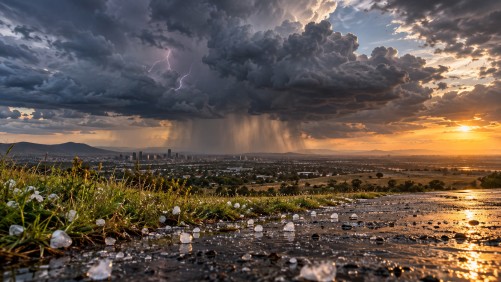
Residents in South Africa’s KwaZulu-Natal, Free State, and North West provinces should brace for potential severe weather on Wednesday, October 14, 2026, as meteorologists forecast thunderstorms, hail, and elevated temperatures in these regions. A Yellow Level 2 warning has been issued for KwaZulu-Natal due to the threat of severe thunderstorms, while a heatwave advisory is in effect for the north-western areas until Thursday.
In KwaZulu-Natal, the day will begin with morning fog in the far western interior, transitioning to partly cloudy skies with warm to hot conditions. The region can expect scattered showers and thunderstorms in the south-west, with isolated showers anticipated elsewhere except in the north-east. Coastal winds will vary, shifting from southerly to south-westerly and then to north-easterly. Residents are advised to protect themselves from the high UVB sunburn risk.
Durban, in particular, will experience partly cloudy skies with isolated showers and thunderstorms. Light winds will shift towards the north-east from late morning, and temperatures are predicted to range between 21°C and 27°C. The UVB sunburn index is notably high, urging caution for those spending time outdoors.
The Free State will see partly cloudy, windy, and warm to hot conditions, with isolated showers and thunderstorms. Scattered storms may occur in the extreme north-west. Bloemfontein is expected to have partly cloudy skies with the possibility of isolated showers and thunderstorms, although specific temperature details are not provided.
In the North West province, partly cloudy weather with warm to hot conditions is anticipated, along with isolated showers and thunderstorms. Scattered storms are also possible in the extreme west, specifically in Mahikeng, where temperatures will range from 17°C to 31°C.
Authorities advise residents to stay updated with local weather reports and take necessary precautions during thunderstorms and high temperatures. Awareness and preparation can help mitigate the potential impacts of these weather conditions.